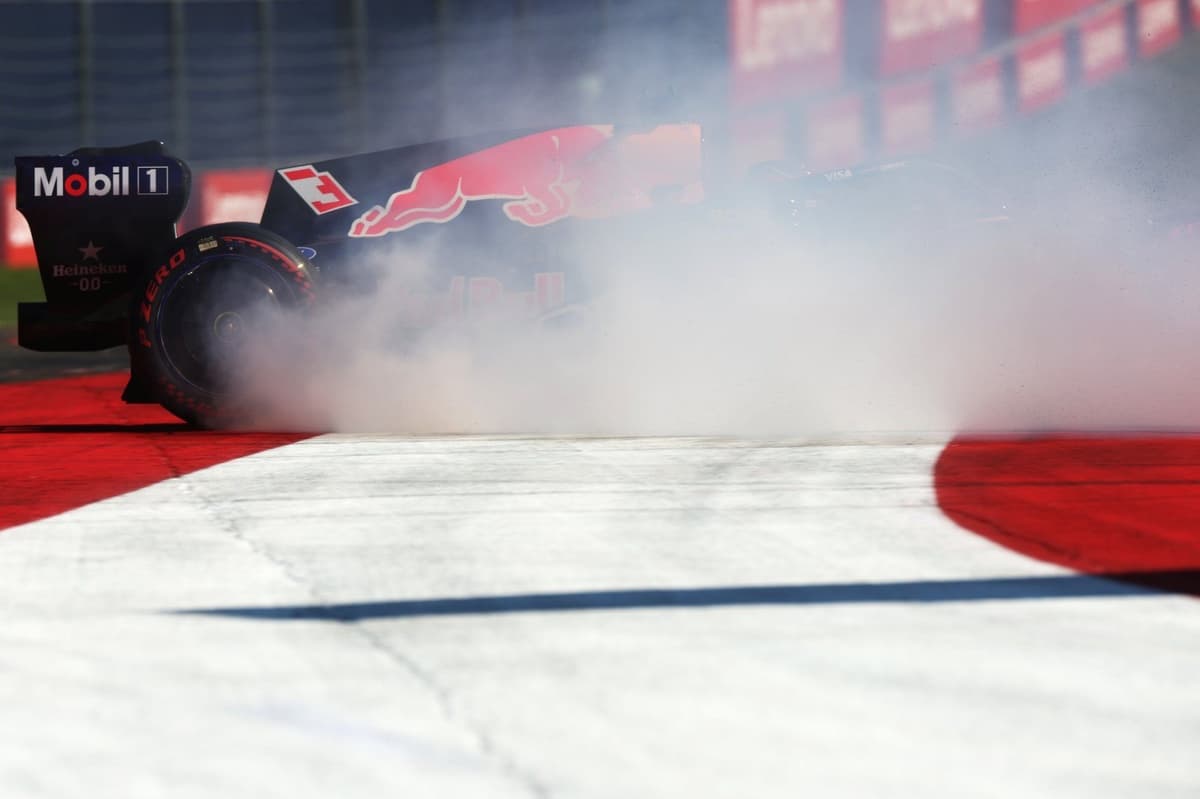
Max Verstappen in the Red Bull Racing RB22 at the 2025 Austrian Grand Prix at the Red Bull Ring
The Austrian GP turns sour: Verstappen takes on the FIA over yellow flags
The 2025 Austrian Grand Prix will be remembered for more than just what happened on track. A row that dominated paddock conversation at the Red Bull Ring saw Max Verstappen, the reigning world champion, openly round on the FIA over what he described as an unacceptable delay in deploying double yellow flags following his qualifying crash. The incident has once again thrown a spotlight on how Formula 1 manages safety on track — and on the role of the marshals tasked with doing so.
Verstappen's crash: what happened and when
It all unfolded during qualifying at Spielberg, the circuit Red Bull calls home. Verstappen was pushing his RB22 to the absolute limit when, as early as three corners before the fateful Turn 9, the rear of the car had already begun showing worrying signs of instability. A warning that was not enough to prevent what came next.
At the entry to Turn 9 — one of the fastest and most unforgiving sections of the entire Red Bull Ring layout — the rear of the car snapped away sharply, pitching Verstappen hard into the barriers. It was a significant impact, and the collective sigh of relief in the paddock was palpable when the Dutchman climbed out of the car under his own steam, declaring he was "fine, or at least as fine as possible", with that characteristic dry wit of his.
The crash, however, had repercussions well beyond Verstappen's own race weekend. The interruption to qualifying at its most critical moment scrambled the timesheets and affected several drivers. Andrea Kimi Antonelli, in particular, aborted his flying lap as a direct consequence of the accident, losing a genuine opportunity to improve his grid position. Verstappen himself later conceded that, without the shunt, he would likely have finished third in qualifying — just behind the two Mercedes.
"It's madness": Verstappen speaks out in the media pen
It was in the post-qualifying media pen that the controversy really took hold. Verstappen made no effort to conceal his frustration at how the marshals had handled the situation. The crux of his complaint was straightforward: after a crash of that severity, at one of the fastest and most dangerous points on the circuit, he expected the immediate display of double yellow flags — the signal that requires drivers to prepare to stop and strictly prohibits the improvement of lap times.
Instead, at least initially, only a single yellow flag was reportedly shown. In Formula 1, that distinction is anything but trivial. A single yellow demands caution and prohibits overtaking, but a double yellow signals imminent danger and obliges drivers to reduce speed significantly — making it virtually impossible to set a competitive time.
In Verstappen's view, the delay in escalating to double yellows was not merely a procedural error, but a genuine safety issue. "It's madness," the world champion said bluntly, insisting that a crash of that magnitude at that particular point on the track should have triggered the most severe response from the marshals immediately.
His reference to Antonelli was not a throwaway remark. Verstappen had initially called the Italian's decision to abort his lap "a mistake", believing the double yellows would be shown. But therein lies the very contradiction Verstappen was keen to highlight: if he himself was expecting double yellows, then the situation clearly warranted them — and yet, at first, they were not displayed.
The FIA responds: standard procedure was followed
The FIA did not let Verstappen's criticism pass without a response. The governing body issued an official statement explaining that the marshals had followed standard, regulation-compliant procedure. According to the federation, each flag is displayed in a progressive and coordinated sequence, with signals propagating along the circuit from the point of the incident outwards.
In short, the FIA maintains that there was no abnormal delay: marshals acted in line with established protocols, with a single yellow as the initial response and double yellows displayed once the full extent of the danger had been assessed. It is a technically sound and formally defensible explanation — but one that has not entirely convinced the Formula 1 world, and has certainly done nothing to placate Verstappen.
Safety in F1: a debate that never goes away
The episode reopens a debate that Formula 1 never truly puts to rest: the management of on-track safety and the reaction times of those responsible for race control. It is far from the first time that drivers and teams have complained about responses that were too slow or insufficient from the marshals, and it is unlikely to be the last.
It is worth remembering that the Red Bull Ring is a relatively short but extremely quick circuit, with sections where Formula 1 cars reach enormous speeds. Turn 9, the scene of Verstappen's accident, is precisely one of those points where even a second's delay in signalling danger can have severe consequences.
- Single yellow flag: hazard in the area, overtaking forbidden, reduce speed
- Double yellow flag: imminent danger, be prepared to stop, improving lap times strictly forbidden
- Virtual or full Safety Car: full speed control enforced across the entire circuit
In practical terms for drivers in qualifying, the difference between a single and a double yellow is enormous. With a single, there is still a slim hope of salvaging a lap by lifting just enough; with a double, any attempt at a competitive time is effectively out of the question. That is precisely why Verstappen's complaint carries genuine weight.
Ferrari's perspective: a tricky weekend at Spielberg
While Verstappen was locked in his dispute with the FIA, Ferrari were having a difficult time of their own in Austria. Charles Leclerc described the SF-25's behaviour at Spielberg as "very strange", and the circuit has traditionally been a tough one for the Scuderia — a layout where the balance between power and aerodynamic downforce must be struck with surgical precision, and one where Leclerc struggled to find the right set-up throughout the weekend.
In that context, the yellow flag controversy added yet another layer of tension to an already fraught few days. For Ferrari, though, the focus remains on maximising race results and capitalising on whatever opportunities yellow flag periods, safety cars, or the unpredictable nature of Formula 1 itself might bring.
Conclusion: will the FIA be forced to revisit its protocols?
The issue Verstappen has raised is unlikely to be settled by a simple statement from the FIA. The world champion has prodded a real sore point: the management of on-track emergencies, the speed of marshal response, and the consistency of safety protocols are topics the paddock watches with obsessive attention — particularly in the wake of recent incidents that have brought driver safety sharply back into focus.
It remains to be seen whether the FIA will launch an internal review of its procedures, or simply reiterate that its marshals acted correctly throughout. In the meantime, Verstappen has delivered a clear message: when it comes to safety, the world champion is not prepared to let anything slide. And on that point, at least, it is hard to argue with him.
Source: Motorsport.com
Newsletter
Stay updated on Ferrari and F1
New articles, technical analysis and Ferrari updates — straight to your inbox.
No spam. You can unsubscribe at any time.